India eSIM: Arriving, Registering and Getting Data in the First Hour

Roami Team
Roami offers reliable eSIM plans, serving over 1 million travelers annually, and supports automatic local network switching to help travelers stay connected globally.
📑 Table of Contents
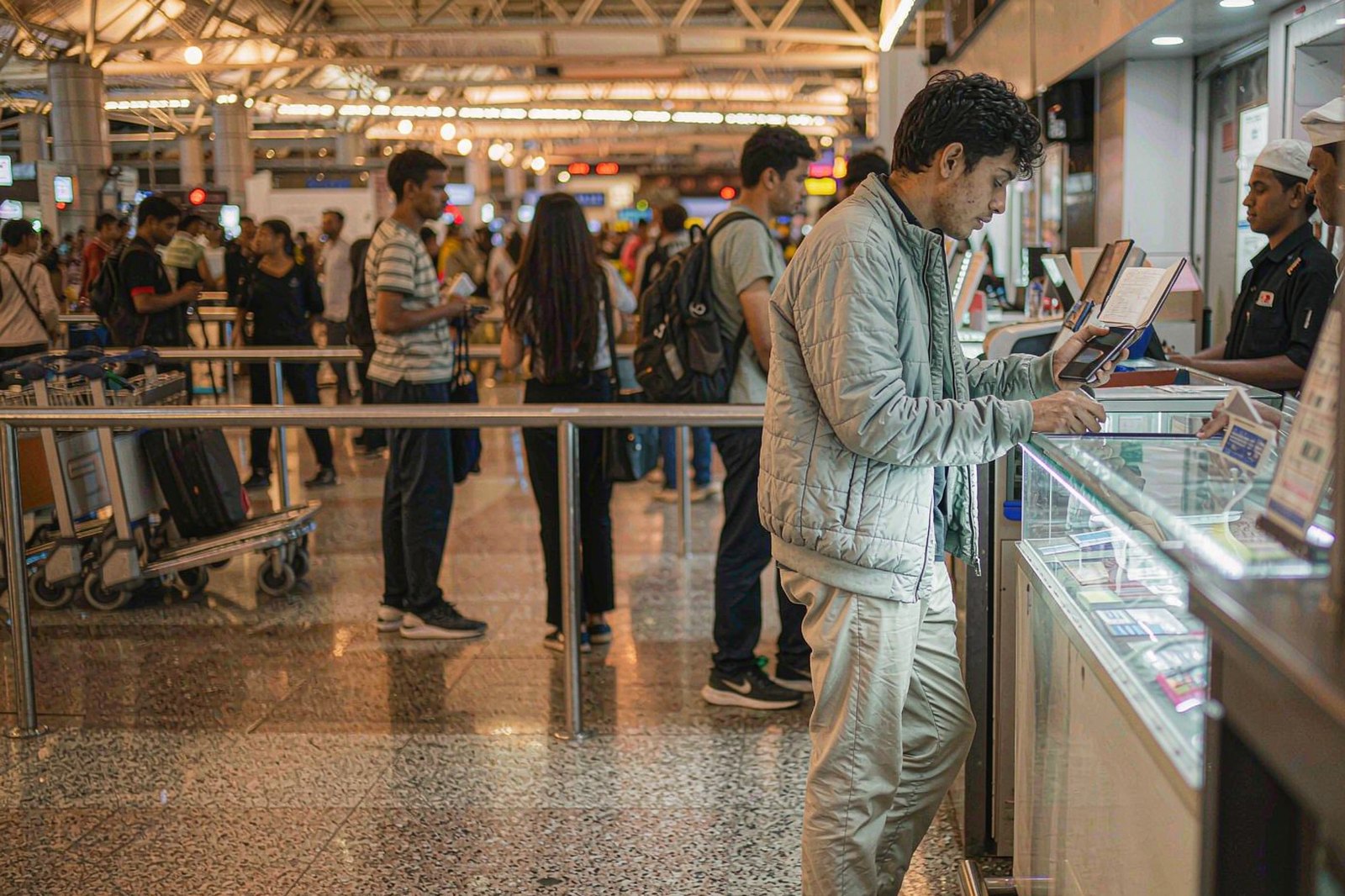
India is the only large market where the cheap data comes with a paperwork queue, and the paperwork is not a formality you can skip by looking confident. Six rupees a gigabyte is real. So is the counter that wants your passport, your visa, an address in India and a photograph taken on the spot, with a two-hour wait before the line goes live.
Whether an India eSIM is worth that trade depends on three things nobody puts in a comparison table: what time you land, how long you are staying, and whether anything you have booked needs a callback to an Indian number.
This page is about arrival. What happens between the aircraft door and a working data connection, which of the four purchases you can actually make at that hour, and where the whole thing goes wrong.
The price arithmetic lives in the per-gigabyte comparison, and the question of whether you need an Indian number at all is handled separately, because it is a different decision with a different answer.
Ninety Minutes From the Aircraft Door to a Working Phone
The queue is not at immigration. It is after baggage, in a hall where three things compete for the same twenty metres: the currency exchange, the taxi desk and the SIM counter. Everyone arriving on your flight walks through it at once.
The order that saves the most time is not the obvious one. Get cash first, because the SIM counter and the taxi desk both take cards but the card machine at 02:00 is the piece of equipment most likely to be down.
After that, decide about the taxi, because a pre-paid taxi voucher needs cash or a working card and takes four minutes, while a ride-hailing app needs a working data connection you may not have yet. Then the SIM, if you still want one.
| Step | Where it happens | Time if it goes well | Time when it does not |
|---|---|---|---|
| e-Arrival QR scan | Immigration, before the officer | 20 seconds | 15 minutes at a self-service kiosk |
| Baggage and customs | Belt, then green channel | 25 minutes | 50 minutes on a full wide-body |
| Cash or ATM | Arrivals hall | 6 minutes | 20 minutes if the first machine is empty |
| Taxi or app | Pre-paid desk or kerbside | 5 minutes | 25 minutes at peak |
| SIM counter, tourist pack | Arrivals hall kiosk | 30 minutes | 2 to 24 hours for activation |
Two of those five rows are fixed costs. The last one is the variable, and it is the only one you can move to a different day. The whole argument of this page fits in one sentence: the SIM is the only arrival task that can be done before you fly, and the only one where doing it early costs nothing in convenience.
The counter is staffed around the international arrivals bank, not around the airport’s opening hours. When two or three wide-body arrivals land inside the same hour, forty people reach the kiosk together and one person is checking documents. Before you join a queue, look at whether the desk has two staff or one.
If it is one, the queue moves at roughly four minutes per person, and you can do that arithmetic yourself while standing in it.
The piece of paper most people forget
Your visa is not in your passport. If you entered on an e-visa, the approval is a PDF you printed at home, and the counter needs to see it.
A photograph of it on your phone is not the same document, and the person behind the desk is not being difficult when they say so: the KYC record has to reference a document type, and a screen is not a document. Print two copies before you leave. One goes in the bag that stays with you.
The same logic applies to your address in India. A hotel booking confirmation is the usual answer, and it needs to show the property’s address, not just its name. A confirmation email with a booking reference and a city name but no street address is the single most common reason a KYC attempt fails and the traveller has to step out of the queue, find WiFi, and come back.
The e-Arrival Card Closes 72 Hours Before Landing
Since 1 April 2026 the paper arrival card is gone. Every foreign passport holder, and every Overseas Citizen of India cardholder, files an electronic arrival card before landing, and the form only opens 72 hours before the scheduled arrival time. Filing it three weeks early is not possible.
Filing it in the immigration hall is possible in the sense that the airport will not turn you away, but the officer will point you at a self-service terminal and the queue behind you will learn your name.
The form lives at the government’s own portal and produces a QR code. Have it on the phone and also saved as a screenshot, because the QR is scanned at a desk where the WiFi is not for you. The information it wants is the same information the paper card wanted: passport details, flight number, address in India, and a declaration about what you are carrying.
Three details trip people up. The address must match the one you will give the SIM counter, or at least not contradict it. The flight number must be the one you actually land on, so if the airline rebooked you, edit the form rather than the story.
The form is per person, not per booking, which matters for a family of four who assumed one submission covered the group.
There is a version of this where the QR code fails to load at the desk because the phone has no data yet. That is the argument for the screenshot, and for keeping the confirmation email offline-available. The same reasoning argues for the sequence in the next section, because the arrival card and the SIM both want to be finished before you need a network to finish them.
Four Documents, a Photograph and Nobody Else’s Signature
The KYC requirement is the part of the Indian system that travel eSIM sellers built their business on, and it is worth being precise about what it actually demands, because half the confusion online comes from people describing a rule that no longer applies or a workaround that never existed.
You need your passport, in original, not a copy. You need the visa, printed. You need an address in India, evidenced. And you need to be physically present, because the retailer takes your photograph at the counter and the connection is registered against a live verification, not a form you filled in on a website.
| Document | What counts | What does not |
|---|---|---|
| Passport | Original booklet, valid beyond your stay | A photocopy, a scan, a photo on a phone |
| Visa | Printed e-visa approval or a stamp | A screenshot, a booking reference |
| Address in India | Hotel or host confirmation with a street address | A city name, a booking number alone |
| Photograph | Taken at the counter | A photo you brought |
| Presence | The passport holder, in person | A friend buying on your behalf |
That last row is a rule rather than a preference. Third-party purchase of a connection is prohibited, and retailers that used to sell a SIM to a driver who then handed it to a passenger have been pushed out of the market. Every adult on the booking needs their own visit.
A family of four is four KYC records, four photographs, and four sets of documents, even if three of them are children old enough to hold a phone.
Activation is not instant. The retailer submits the record and the line comes alive somewhere between two and twenty-four hours later, which is a range wide enough to break a plan built around “I will sort it at the airport.” If you land at 22:00 and the activation lands at 09:00 the next morning, you have spent a night in a hotel with WiFi and no way to call the driver who is waiting outside.
Why one passport buys one number
The limit that surprises long-stay travellers is that a single passport supports a single connection at a time. Not one per visit: one. The scale behind that rule is worth seeing: India’s cellular connections outnumber its residents, and each one is a verified record tied to a document.
A second attempt on the same passport is refused until the first is deactivated, and deactivation means a trip to a store with the same documents again.
For a two-week holiday this is invisible. For anyone staying eight weeks, or returning twice in a season, it is the detail that decides whether a local SIM is worth the trouble at all.
There is a real cost to the ninety-day clock running out while you are still in the country, and it is not a top-up problem; the line simply stops being renewable and the counter cannot extend what the licence does not allow.
Ninety Days Is the Ceiling, Not the Plan Length
A tourist connection is issued for ninety days or until the visa expires, whichever comes first. The ninety is a ceiling on the licence, not a recommendation, and it does not extend because you bought a longer pack. If your visa is a thirty-day tourist visa, thirty days is your number.
This matters for two groups. The first is the long-stay traveller on a six-month tourist visa who plans to keep the same number for the whole trip: you will re-register at day ninety, with the same documents, at a store, and the ninety-day clock starts again.
The second is the traveller who arrives in October and returns in February, assuming the number survives. It does not. A deactivated connection is deactivated, and the passport holds one record at a time.
The practical consequence is a decision rule. If your trip is under three weeks, buy data in a form that does not need a counter and treat any local number as optional.
If your trip is over six weeks, the local connection is cheap enough that the re-registration trip is worth planning into a specific day, ideally one when you are in a city with a flagship store rather than a village retailer.
Prices explain the temptation. A twenty-eight-day pack with two gigabytes a day runs about ₹299 on Jio, ₹299 on Airtel, and ₹299 on Vi at a lower daily allowance of one and a half gigabytes. Extend to eighty-four days and Jio quotes ₹799, Airtel ₹839.
Compare that with any travel product priced in dollars and the rupee wins on paper by a factor of ten.
What the table does not show is the hour you spend at the counter, the two-hour activation wait, the printed visa, the hotel address, and the fact that the connection dies at day ninety. Add those up and the factor of ten shrinks. For a fortnight it disappears entirely.
Why a Travel eSIM Never Sees the KYC Desk
The reason an eSIM you buy from a travel seller does not require Indian documents is not a loophole and it is not a favour. The difference is regulatory rather than commercial.
An eSIM for India sold abroad is a profile issued by a foreign operator under the GSMA’s remote SIM provisioning standard. When you land in India, your phone attaches to an Indian network, but the subscription behind the profile belongs to the foreign operator.
The Indian network is providing radio access, not selling you a connection. Nobody is opening a subscriber record in India, so nobody needs your visa.
That single fact produces every other characteristic of the product, good and bad. It is why you can install it in fifteen minutes at home. It is why it is data-only: a voice number belongs to the subscription, and the subscription is not Indian.
It is why the price per gigabyte is several times the local rate, because the foreign operator is buying wholesale access and reselling it. And it is why the quality can vary between sellers using the same network, since the wholesale arrangement behind the brand is not the same arrangement.
The regulatory plumbing is worth knowing about even though it rarely affects a tourist. India requires IMEI registration for handsets sold or activated in the country, through a system called CEIR. A travel eSIM used in roaming is not the same transaction, and tourists are not the target of that rule.
The rule, though, is set by administrative order rather than by statute, which means it can be widened without a parliamentary debate. Anyone whose trip depends on a specific device working should check the current position rather than trust a blog post, including this one.
The Counter Has Nothing for an eSIM-Only Phone
Here is the failure that ruins an arrival more often than any other, and it is a hardware problem rather than a paperwork one.
Since the iPhone 14, models sold in the United States have no physical SIM tray. If you are travelling on a US handset, the airport counter cannot give you a local connection in the form you can use, because what they sell is a plastic card and there is nowhere to put it.
The retailer will not be able to help, not because the staff are unhelpful but because the product does not physically interface with your phone.
Local eSIM conversion exists, and both Airtel and Jio support it. Airtel takes an SMS to 121, replies inside a minute, runs a voice authorisation, and emails a QR code that arrives roughly two hours later. Jio takes an SMS reading GETESIM to 199, returns a nineteen-digit virtual eSIM number, and pushes the profile after an IVR confirmation.
Vi answers an SMS to 199 and expects a reply of ESIMY. None of these paths start from nothing: every one of them assumes you already hold an Indian number, which is exactly what you do not have before the counter.
Whether a given store will issue a fresh tourist connection as an eSIM rather than a plastic card varies by circle and by store, and it is not something to build an arrival plan on. The reliable statement is narrower: if your phone has no SIM tray, plan to arrive with data already installed, because the fallback is not a queue, it is a dead end.
Two Slots, Three Jobs: Data, Calls and the Bank
A dual-SIM phone in India is doing three jobs at once, and the default settings do two of them badly.
Job one is data, which belongs to whichever line you bought for data. Job two is incoming SMS, which is how your bank, your airline and half the services you already pay for reach you. Job three is voice, which almost nobody needs and everybody leaves switched to the wrong line.
Set the travel eSIM as the data line and leave the home line active for calls and messages. Incoming SMS on a roaming home line is normally free to receive, which is why the bank can still reach you. Outgoing calls on that line are where the money goes, and a five-minute call to a hotel desk can cost more than a gigabyte of local data.
Turn on data roaming for the travel eSIM. This trips people up constantly: the profile is a roaming profile, so with roaming switched off it shows signal and passes no traffic. Turn data roaming off for the home line at the same time, so the phone cannot quietly use it when the travel line drops.
Switch off mobile data switching, the setting that lets the phone hop between lines when one is weak. It sounds helpful. In practice it is the mechanism by which a phone bills a background sync to the expensive line at three in the morning.
WiFi calling on the home line is worth a thought before you leave. Calls over WiFi are billed as though you were at home, which is usually far cheaper than the roaming rate, and it works from any hotel network. The caveat is that it does not work everywhere and the carrier decides, so test it once at home rather than discovering the behaviour on a hotel WiFi in Jaipur.
The First Hour, in the Order That Actually Works
The order below assumes a travel eSIM installed before departure and a phone with a working SIM tray or an eSIM slot free.
Land, and leave the phone in airplane mode until you are through immigration. There is no benefit to attaching to a network in the immigration hall, and the eSIM will attach faster once you are outside the concrete.
Clear immigration with the QR code on screen and the printed visa in hand. Collect the bag. Walk past the exchange desk if the rate is bad, but take cash, because the first hour is not the moment to discover that a card terminal is offline.
Find a quiet metre of floor near the exit, and only then turn off airplane mode. Wait for the network name to appear rather than tapping through settings impatiently. The profile attaches in under a minute on a good day.
Open a browser and load a real page rather than trusting the signal bars. A profile can show four bars and pass no traffic if the APN is wrong, and the APN is normally set automatically by the profile. If nothing loads, check the APN field before you check anything else, then restart the phone once.
Book the taxi. If you are using a ride-hailing app, this is the moment the data connection earns its cost, because the alternative at that hour is a pre-paid voucher queue and a driver who does not know your hotel.
Message whoever is meeting you. This is the last step, not the first, and doing it in this order is what stops the whole sequence from depending on one app loading.
The APN detail that is not a detail
An eSIM profile carries its own APN, and it is normally applied automatically. When it is not, the phone shows full signal and no internet, which reads as a broken plan and is almost never one. The fix is to look at the mobile data settings for the travel line and confirm the APN field is populated.
An empty APN field on an active profile is the single most common installation fault, and it takes twenty seconds to check.
The second most common is a phone that is carrier-locked. A handset bought on a contract with a lock cannot use any of these options, local or foreign, and no amount of queueing changes that. The supported-phone check settles the model question in a minute; the lock question is answered by the carrier that sold you the phone.
If You Connect to a Domestic Flight, the Queue Moves
Most long-haul arrivals into India are not the final destination. The ticket says Kochi or Agra, the aircraft lands at Delhi or Mumbai, and the connection is a separate boarding pass in the same booking.
You clear immigration at the first airport you touch, not at the end of the itinerary. That is where the e-Arrival QR is scanned, where the visa is looked at, and where the SIM counter lives. If your plan was to sort out data at the domestic terminal, there is no such counter there, because domestic passengers are not arriving from anywhere.
Bags behave differently depending on how the ticket was sold. On a single booking the bag is normally through-checked and you see it at the final airport. On two separate tickets you collect it, clear customs, and re-check it at the domestic desk, which is a different building at some airports and a shuttle ride away at others.
Ninety minutes is a working allowance for an international-to-domestic transfer at a large airport, not a guarantee. The inter-terminal shuttle is frequent; the security queue at the domestic terminal is its own queue with its own peak. If the connection is tight, do the SIM after the domestic leg rather than before, and accept that the domestic terminal’s WiFi will have to carry you until then.
The last wrinkle is the arrival card. It is filed against an international flight and an arrival airport, so it covers the international leg only. The domestic leg needs no card, no QR and no second queue. Anyone who has filed one for Delhi and then flies onward to Goa has already finished the paperwork.
What Happens When the Aircraft Lands Somewhere Else
Diversions are rare and they are not evenly distributed through the year. In northern India the fog season runs through the coldest weeks of December and January, and a Delhi arrival can end up on the ground at Jaipur or Lucknow with the passengers bussed or rebooked.
The arrival card is tied to a flight number and a port of entry. A diversion means the QR in your hand names an airport you are not standing in. In practice this is handled, because it happens every winter and the officers have seen it, but it is handled manually at a desk rather than by a scanner, and that desk is not the one you were queuing for.
What it breaks is any plan that depended on a counter at the intended airport. A local connection bought at the diversion airport is a different circle, sometimes a different operator, and always a different record.
The travel eSIM does not care: it attaches to whichever network is present, which is the one genuine operational advantage of the roaming product over the local one, and it is the reason a five-dollar backup on a phone already holding a local pack is not a waste of money for a winter arrival.
230 Volts, Three Sockets and One Adapter
The electricity is 230 volts at 50 hertz, which is fine for phones, laptops and camera chargers rated for 100 to 240. Check the brick rather than the plug: the rating is printed on it, and a brick that says 100 to 240 needs only a mechanical adapter.
Sockets are the part people get wrong. India uses type C, type D and type M, and a modern hotel room will often have a universal socket that takes all three plus a UK plug. An older building may have only the type D three-round-pin socket, which nothing you own fits without an adapter.
Carry one universal adapter rather than three cheap ones, and carry it in the cabin bag rather than the checked one, because the useful moment for it is the hour after landing when the phone is at four per cent.
Power banks belong in the cabin. They are not permitted in checked baggage, and an airport security queue is a bad place to discover that the rules are enforced rather than printed.
The other charging detail worth planning is that airport charging points are contested at exactly the hours when the international arrivals bank is dense, so a charged bank at landing is worth more than a plug you have to wait for.
Where the Network Stops Being Useful
India’s mobile data is genuinely fast in the places most trips go. Ookla’s national median in August 2026 was 128.20 Mbps, ranked 32nd in the world, on a median latency of 26 milliseconds. That is faster than most European countries and it is not a fluke of a small sample.
The market behind the number is three private operators and one state-run company, which is why the speed figures split so widely by operator.
The split between operators is wide enough to be worth knowing. Jio runs a standalone 5G core, and its median 5G download of 258.54 Mbps comes with 73.7 per cent 5G availability and 83.7 per cent consistency. Airtel runs non-standalone 5G, with 205.10 Mbps on 5G and 100.67 Mbps across all technologies, and 79.8 per cent 5G consistency.
Vi, the third private operator, sits at 21.60 Mbps across all technologies, which is the number that explains why a plan landing on Vi feels like a different country.
That last figure matters more than the headline. A travel eSIM does not let you choose the network; the provider’s wholesale agreement decides it, and sellers list the landing network on the plan page. Read that line before you buy, because a plan priced like a premium product and landing on Vi in a city where Jio is fast is a bad trade that no amount of data allowance fixes.
Coverage thins in the places that are not cities, and it thins differently by operator. Motorway corridors hold up well. The approach roads to hill country are patchy in a way that is normal for terrain rather than a fault.
A village two hours from a state capital may have one operator and not the others, which is the argument for a phone that can hold two profiles and for not cancelling the home line before you leave.
Five Ways the Arrival Goes Wrong, and What Each One Costs
| What went wrong | Why | The fix, in the order to try it |
|---|---|---|
| QR code will not load at immigration | No data yet, no screenshot saved | Use the airport’s self-service terminal; the officer will direct you |
| Counter refuses the KYC record | Address on the booking has no street address | Show the hotel’s own confirmation with the full address, or call the hotel |
| Phone shows signal, nothing loads | APN field empty, or roaming off for that line | Check APN, then data roaming for the travel line, then restart once |
| Line not active after two hours | Activation window is 2 to 24 hours, not 2 hours | Do not re-queue; the retailer cannot speed up a submitted record |
| Phone has no SIM tray | US iPhone 14 or later | Nothing at the counter will help; this has to be solved before departure |
The pattern in that table is that four of the five failures are recoverable and one is not. The one that is not is the hardware mismatch, and it is the only one entirely within your control three weeks before the flight. That is why the arrival question and the purchase question are really the same question asked at two different times.
Three Purchases Costed in Hours, Not Rupees
Compare three purchases on the same fortnight, and the money is not the interesting column.
A travel eSIM installed at home costs fifteen minutes before departure and nothing on arrival. Ten gigabytes over thirty days runs around $17.50 to $24 at Airalo, $23.99 at Saily for the same allowance, and Nomad prices a twenty-gigabyte month in the low twenties.
One gigabyte for a week is $3.99 to $4.50 depending on the seller, which is the number to remember when someone says travel eSIMs are expensive: the one-gigabyte pack is where the premium lives, and the ten-gigabyte pack is where it evaporates.
The tourist pack at the airport costs the queue, the activation window and the documents, and returns a gigabyte a day for four weeks at about ₹500. Priced per gigabyte that is competitive with nothing and cheaper than a bad travel plan, which is the honest version of the comparison.
A prepaid pack from a city store costs the same documents, a shorter queue, and a two-hour activation, and buys two gigabytes a day for ₹299. On a three-week trip it is the cheapest data in the world by a wide margin. It also cannot be bought before you land, which means it cannot solve the first-night problem it is being compared against.
The number that decides it for most people is not the price per gigabyte. It is how many hours of the trip you are willing to spend on administration, and whether the first of those hours is at two in the morning after a nine-hour flight.
Six Arrivals, Six Different Answers
Landing at 02:40 with a hotel transfer booked. Install before you fly. The transfer driver is holding a name card, not a phone number, and you need to message the hotel that you have cleared. A local SIM at that hour is a two-hour activation and a queue with one desk open.
Landing at 09:15 with a pre-paid taxi voucher. You have daylight and patience. The counter is an option if you are staying three weeks or more, and the rupee price is unbeatable if you are. Otherwise skip it.
A fourteen-day Golden Triangle with a driver. Your driver will call. An Indian number is genuinely useful here, but the driver can also use WhatsApp on your home number. Ask before you buy anything, because a good operator will simply message you.
A five-week stay in one city. Buy local. Two gigabytes a day for ₹299 is not a price you should be paying in dollars for five weeks, and the re-registration trip at day ninety does not apply to you.
A business trip with a corporate roaming plan already paid for. Do nothing, and check that the plan covers data rather than only voice. Corporate plans often do, and the eSIM is then a backup rather than a purchase.
A family of four on one booking. Four KYC records if you go local, four photographs, four document sets, and four separate queues if the desk is processing one at a time. The travel eSIM route costs more per person and collapses that into one purchase made at home.
Two Weeks In, What Actually Fails
The arrival goes wrong in obvious ways. The middle of the trip goes wrong in quiet ones, and they are worth knowing because the recovery is different.
The first is a pack that expires rather than runs out. Day-counted products stop when the calendar says so, and the symptom is sudden: every app fails at once, including the provider’s own account page, which is how you tell validity from exhaustion. A data-exhausted pack usually leaves the account page reachable and the rest unusable.
The second is a wiped profile. Wiping a phone, or a factory reset done to fix something unrelated, deletes the eSIM along with everything else. The profile is bound to the device’s electronic identity, so it cannot simply be copied back from a backup the way an app can.
Recovery is a reissue from the provider, usually once at no charge and after that for a fee, and it needs a working internet connection, which is the awkward part when the reason you are resetting is that nothing works.
The third is a lost or stolen phone, and it is the one where the local product and the travel product differ most. A plastic SIM can be replaced at a store with the same documents.
An eSIM cannot be transferred to a new handset by the user, only reissued by the issuer, and a local issuer will want the KYC record again and possibly a replacement fee. Neither route gets you a number back the same day.
The fourth is the quiet one: a background sync that ran all night on the home line because data switching was on. It does not announce itself. It shows up as a bill three weeks later, and the fix was a toggle you could have set before departure.
What Changes If You Hold an OCI Card
An Overseas Citizen of India card changes the arithmetic, because an OCI holder is not on a tourist visa and the ninety-day ceiling does not apply in the same way. The documents at the counter still include the passport and an address, and the OCI booklet or card is what the record references.
The practical difference is length of stay and the ability to hold a connection across visits, which makes the local route far more attractive than it is for a two-week tourist. It also means the Indian number becomes worth having for banking, for property, for anything with a one-time password attached, which is the subject of the number page rather than this one.
If you are travelling on a business visa, the same applies with a different document. If you are travelling on a student visa, the connection is issued against the visa and the institution’s address, and the counter will want the admission letter. None of these are tourist purchases, and none of them are solved by a travel eSIM, which is why the two products coexist rather than compete.
Nine Questions People Ask Before Landing
Does India have eSIM? Yes, and all three private operators issue them. What India does not have is an eSIM a tourist can buy without KYC, which is why the travel product exists as a separate category.
Is an eSIM available in India for someone arriving tomorrow? Available, yes. Installable tomorrow, only if you buy it before you fly. The local version needs a counter visit.
Can I buy an eSIM for India travel from the USA before departure? That is the normal way to do it, and the profile installs over your home WiFi in about fifteen minutes. The one thing to check first is whether your handset is carrier-locked.
Will my phone work on an Indian network? Any recent iPhone or flagship Android will. The compatibility list answers it by model, and the lock question is answered by whoever sold you the phone.
Do I need the e-Arrival Card if I hold an OCI card? Yes. The requirement covers foreign passport holders and OCI cardholders alike, and it opens 72 hours before arrival.
Why is the local data so much cheaper? Because it is sold by an operator with its own network to a subscriber it has verified in person. The travel product is a resold wholesale arrangement, and the margin sits on top of the same radio access.
Can I top up a local pack with a foreign card? Often not. A foreign card tends to fail at the bank’s own security check rather than at the operator’s end. Vouchers bought through an Indian marketplace, or cash at a phone shop, are the usual workarounds.
What if I only need data for maps and messaging? Then the travel eSIM is the right purchase and the queue is a waste of your morning. Maps, messaging and a ride-hailing app are the whole requirement for most trips, and none of them needs a local number.
Is the India eSIM news about rules changing something I should worry about? The direction of travel has been more registration, not less, and the arrival card is the most recent example. Buy the product that does not depend on a counter, and the rule changes stop mattering to you.
The cost-per-gigabyte ranking prices all four ways to buy data and shows where the premium actually sits. If your trip needs a callback number, the phone number page covers which bookings fail without one. The carrier guide explains why the three networks behave so differently, and the current India plans are the product side. Arriving somewhere else first? The Nepal page covers the most common overland crossing, and the Bangladesh page the other one.